Thursday, December 30, 2021

the bird path

when birds awaken — hungry, owning nothing —
they sing

their feet grasp without effort
holding them to their perches by mechanics, not by muscle

and so, like us, they must use their strength
to let go

Friday, December 10, 2021

the road to our salvation is a path we've walked before

The concept of reindiginization keeps coming up for me. In this case I’m not using the word in the sense of returning lands to native peoples, but rather of how Western peoples in particular made a devil’s bargain: relinquishing our reciprocal relationship with the rest of the natural world for one of extraction and domination.

Like all devil’s bargains, this initially looked like it worked out for us. We benefit disproportionately from extractive industry and have a disproportionately large political and cultural influence over other peoples on this planet. 

The sting is in the tail. Extraction and exploitation, unchecked, will literally destroy the ability of our species to exist on this planet. Even if some proportion of us survive, they will be living in a world stripped of beauty and natural richness.

So how do we undo the devil’s bargain? Robin Wall Kimmerer, indigenous educator and scientist, speaks about how Westerners tell her that they want to partake of indigenous practices because they don’t have any of their own. 

True. We traded those away. 

But, Kimmerer says, appropriation is taking things that have not been given to you willingly. Cultivating a sense of gratitude and love and relationship with the world, with all of our fellow animals and with plants and even with the cycles of water and storms of dust upon which those more familiar lives depend — that gratitude belongs to no culture.

I grew up thinking of animism as a more “primitive” way of seeing the world, but now I see it as a pathway. We don’t need to adopt the words or thoughts of any particular culture; we need to learn to see the intrinsic value, the “personhood,” of everything with whom we share this planet, living and nonliving alike.

That shift in thinking is, I think, the only thing that can save us. “Managing natural resources” and “sustainable development” maintain the extractionist mindset. 

There are no natural resources. There are only gifts, and the world continues to be open-handed. Humanity must relearn how to reciprocate that generosity.
Thursday, September 20, 2018

middle age

the midpoint between hope and resignation.

the time when everything goes wrong 
for everyone you know.

parents, diagnoses, marriages, careers, addictions
children, or the lack of children.

the age when, if you're lucky,
you've accumulated enough money to know for sure
that it will not make you happy.

tired out; at the place that runners call the wall.

they say that if you run through you get a second wind,
and maybe the peace of older people is just that --

patched sails belled out, carrying
you and your motley crew ever onward
into uncharted waters.

easy. the wind at your back.
all downhill from here.

Saturday, September 15, 2018

The letter I did not write to Ursula Le Guin

Your writing has always felt so clean to me,
like a room swept out in anticipation.
Not sterile — soft-edged, everything made by hand.
Neat. Straightened gently.
A room passed through by many, a place of history and expectation both —
bright, full of air, suffused with warmth
and perhaps a breeze or the evocation, through the open window,
of distant winged things.
Such a comfort to me, that place that is your writing.
Aired out, turned over, like the guest room in a monastery,
where every one of a thousand travelers stops
with astonishment and thinks —
all this was done for me.

Thursday, April 20, 2017

Structural Color

The arresting thing about birds is their mundane impossibility.

They arrive weightless from the heights like miracles,
glowing with color that makes you doubt your eyes before they’ve even flown away.

A blue jay appeared this afternoon,
blue so brilliant it can’t be made with pigment, only from pure light,
and bowed to me as if to say

Can you believe this?

And even though I'm on the fence about God,
and miracles, I tell the jay

I believe.

Tuesday, November 24, 2015

What We'll Lose When We Lose The Bees

Not just the fruit of our fields of labor,
the weighted arbor, the blessed abundance of the earth.

Not just the winged alchemists, transmuting tirelessness into gold
season after season.

Not just the buzzing congregation, the heat of their gathered bodies,
expressing through dance their solemn and unshakable purpose.

When we lose the bees we will lose the devoutest of pilgrims,
who dusts her six feet on the doorsteps of a thousand fleeting cathedrals,

who casts faceted eyes over vaulted petals
before heading home in her lifelong chastity, bearing blessings for her sisters:

selfless, industrious, obedient,
all the religion man aspired to after the fall.

We'll lose the one who made the apple. The one who lives still in the garden
and has never drawn one breath in doubt.

Wednesday, November 18, 2015

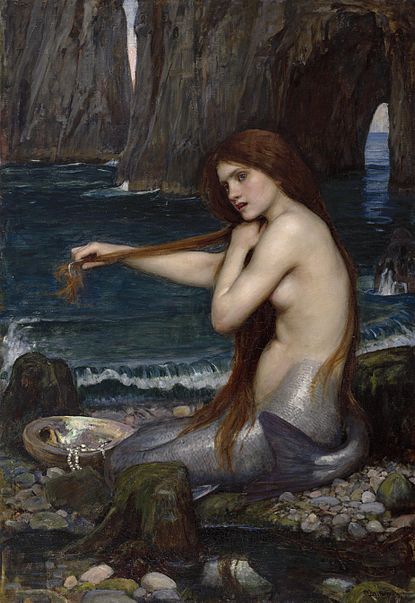
John William Waterhouse, The Mermaid


Sometimes she wonders how it happened: her own creation, the birth of the creature doomed to live between. She sits on the warm rocks, the salt crusting on her skin, her tail slowly drying, combing and combing her long hair.

It was a sailor who taught her that, the combing. He saw her in the wake of the ship, a pale face in the paler foam, and stood transfixed while she hauled herself up a trailing line. Everyone thinks all the strength is in the tail, but that’s not true. If you had to pull yourself from water, your full dead weight unsupported by legs, you would have strong arms too.

So she pulled herself up, and she looked long at him, and he reached out to her with trembling fingers and ran them through her hair. A lifetime of tangling did not make this easy, but he was patient.  Those fingers, so clever with a twist of rope, unwound the knots and made the strands lie smooth and shining.

She stared with sea-blind eyes, at his hands, at his face, at the trembling pulse at his throat. She felt her scales drying slowly in the wind and heat, an uncomfortable pinching, even as the skin of her torso warmed and itched with the pleasure of dry heat.

Her hair once untangled, he ran those subtle fingers over her shoulder, down the small of her back. The fish in her recoiled and the hair of her warm arms stood up in delight, and she leaned in and kissed him, tasted the sweet wet of him with her salt mouth. And then she threaded her strong arms around him like a stand of seaweed and she slipped with him into the waiting waves.

The struggle was brief. He was a thing of air and sun, both of them the enemies of water, both of them quickly extinguished. Her lashing tail and his lashing legs churned the sea. Her eyes, wide in the murk, watched him clearly; watched him move from one element to another, become infused with salt water, heavy laden with it.

She kissed his newly salt mouth and let him slip down into the depths for the crabs to scuttle over, envying him a second time, the abandon with which mortals choose one world or the other. She, the one between, always knew that if she took him it could only be to let him go.

She kept his comb. On the shore near the blessed water, half of her longing for salt and half for sun, she runs it and runs it through her hair.

Thursday, September 17, 2015

Metropolitan


You were face to face with the painting, 
breathing on the wall.

You saw it, recognized it, raised your lens,
looked closely at your screen to check the frame.

But then, your arm still raised, the painting still on screen
I watched you turn your head – already scanning for the next famous face.

Your lens looked longer than your two eyes.
When you scroll back to what you took, I wonder what you’ll see?

A face you’ve seen a hundred times – yes.
A beautiful mask. But not the painting.

Never the painting, breathing on the wall.

Friday, July 11, 2014

Happy Hour

I overheard a young man in a suit tell his friends
"this is the hardest-earned happy hour"
as they hurried by me in the summer rain.

It wasn't heavy rain but still, no doubt,
a threat to Tuesday's polish on their leather shoes.

The phrasing struck me.
How many happy hours have been earned, and at what price?
I thought of countless other lives, less easy, 
the cost of their brief happinesses.

Perhaps I am unfair. Joy isn't earned.
Like summer rain it falls on anyone 
with a hand to cup or an ear to hear 
or a warm skin to prickle with delight.

I feel suddenly tender toward that thirsty boy,
wilting already, so early in the week.
It's not his fault that desert plants must know
how to make every
drop
count.

Friday, May 24, 2013

thanksgiving

these farewell tears are thanks for this,
a friendship like a feast you never finish.

the bitter courses, the rich, the sweet
made by our hands over and over.

gathered around the table, we pass the plates.

i made this for you, we say.
i made this for you.

Tuesday, April 30, 2013

This morning in the subway 
a feather whirled on the floor
in tight counterclockwise circles that moved it down the car.

We were all watching -- 
an Asian man with polished shoes
moved them to let it pass.

“There’s life in you yet,” I thought, picturing the bird from which it came.

But was there ever, really?
Is there life in our hair, our nails, our skin?

How many layers must you peel away to reach what’s truly living --
is it the heart, or the blood,
or the ceaseless tide-rush of air in the lungs?

No. All these are just containers for the nameless, urgent thing
that leaves the birdcage of the body

so silent

when it takes wing.

Monday, January 28, 2013

late winter

yesterday i was walking with a friend in the cold
deep in the kind of conversation that absorbs you completely
and yet can’t be recalled the next day

we were passing an old woman who looked up and cried out

“it’s so light!”

and to me
who claims to suffer all the winter months from darkness
it was like her words lit up the sky

was the light even there before she spoke it?

or must things be named
before they reach my eye?

Thursday, April 05, 2012

realization

I have two quotes that I keep under my transparent desk cover at work, one of which I cut out of a paper, I think from an ad for some kind of funky spiky mattress cover:

free yourself from pain

The other is one of my favorite bumper stickers, which I saw once in high school and never forgot:

don't believe everything you think

They've been sitting there right next to each other for years, but it only just occurred to me that they are a single thought.

Free yourself from pain; don't believe everything you think.

Friday, April 23, 2010

balloon

This is a true story.

A ten year old girl let go a balloon in Northern England
bearing her name and her address.
It traveled a hundred miles south, against the prevailing wind,
to the hand of another ten year old girl
with exactly the same name.
Of all the chances, of all the random currents of air,
it flew straight into the hands of the one
who didn’t even know she was waiting for it.

A statistician, hearing the story, says that
something like this was bound to happen
to someone
eventually.

Poetry is like that.
Set a poem loose in the world and it wanders
losing itself in the ocean
falling in a stream, catching in a tree
but sometimes coming to exactly the right place.

It's bound to happen eventually,
and every time is a miracle.

When the words find the one
who doesn’t even know she is waiting for them,
in that instant,
two chubby hands a hundred miles or years apart
hold tight to the string of the same balloon.

Tuesday, December 08, 2009

above the tree line

Plants here have roots as deep as I am tall
with less than a pinkie’s length of shrubby leaves
and tiny flowers to show for it.

And you’d think it would be snow
that keeps you away in winter –
but really it’s the wind.
Even gentle snowflakes scour the ground bare.

The snow that stays here remembers a time
before men first filled the air with coal dust, and
oh, it could tell you stories –
but it guards its silence in curved shadows,
sullen and unmelting.

Even in spring the colors breathe autumn.
Orange lichens and fast-moving shadows
brush their fingers over land you would swear,
from post cards,
was soft as velveteen.

Here the spirit yearns to rush over the exposed rocks
with their round rainwater mirrors,
longs to glide down the soft-edged hills
toward the jagged peaks far below.

But you can’t run ten yards without gasping.

The air conceals its thinness with a mendacious clarity.
The doors of distance are unlocked, every direction thrown wide open.

Everything is sharp as crystal here, everything is clear as glass –
here it’s all as unreachable as a reflection.

Wednesday, July 08, 2009

... break your mother's back

when I was an angry little girl
filled with the pressing, helpless rage particular to children
I would look for fissures in the sidewalk to step on
and stamp my small foot hard
secure, even at that age, in the falseness of the superstition

but this morning my mother, shrunk now to human size
lay down on the surgeon's table to bare her spine to the knife.

cutting first from the back and then from the front
for nine hours the doctors fought
to put what was wrong right again

in a far off city, I went to work as usual
almost as old now as she was then
but filled once more with the same orphaned powerlessness

all the way from 15th Street to 54th and back
I did not step on a single crack.

Friday, June 26, 2009

bubble

When dreams have shattered or illusions have been broken,
we say the bubble has popped.

But watch one do it in slow motion:
first it bends to accept the pinpoint thrust,
then unpeels from that spot like an opening eyelid.

A herd of droplets gallop away along the retreating edge
like a wave cresting in reverse.

The beauty of a bubble is not
its symmetrical balance of complementary and opposing forces.
It's this inevitable moment.

When a bubble bursts I don't see abandoned hope.
I see a prisoner set free at last; a captive breath
released into the waiting arms of the open air.

Friday, June 05, 2009

Fate

If I were sinking to the bottom
I would be a flat stone, like for skipping.
I would tip from side to side in invisible currents
wobbling my way down to the silt.

Even in this extremity
even in the face of the absolute final outcome
I would be ambivalent.

“Shall I strike with this side or with that
before coming to my predetermined rest
in a puff of sand?”

In my petrified mind this would matter
intensely.

I would tilt back and forth, wildly indecisive
knowing all along that the angle of my future repose
was already determined by the slant of the sand.

We can’t choose our fate –
only the manner of our going to it.
Do we struggle and equivocate
or seek the swiftest, surest path to the end?

Wednesday, January 21, 2009

a poem for the new president

Not Atlas

Don't ask him to be the suffering giant,
bearing the weight of the world on his back.
Don't ask him to support us, carry us,
be our cradle and anchor, the seat of the earth.

He is not Atlas: don't ask him to hold up the sky.

It's easy to mistake the man for the future he points to,
but he isn't the Titan. He is only
an atlas, a book of maps,
showing us as best he can where we are,
the geography of where we must go.

Friday, April 04, 2008

pearl

No one asks the oyster if it wants to make a pearl.

The sand comes in

uninvited.


The oyster does the only thing it can to protect its quivering, salty, delicate flesh.

It excretes layers of iridescence, moist rainbows,

an accretion of moonlight.


I think all beauty is something like this –


un-chosen, necessary

holding something sharp in its heart.